

Forging vs Casting: Which Manufacturing Process to Specify for Critical Metal Components
Forging shapes metal by applying compressive force to a solid billet, aligning the grain flow along the part's contours and producing higher strength, toughness, and fatigue resistance. Casting shapes metal by pouring molten alloy into a mold, allowing more complex geometries but with a higher risk of internal porosity. Forged components are generally specified for stress-critical, safety-critical parts; cast components suit complex shapes where extreme mechanical loading is not the primary concern.
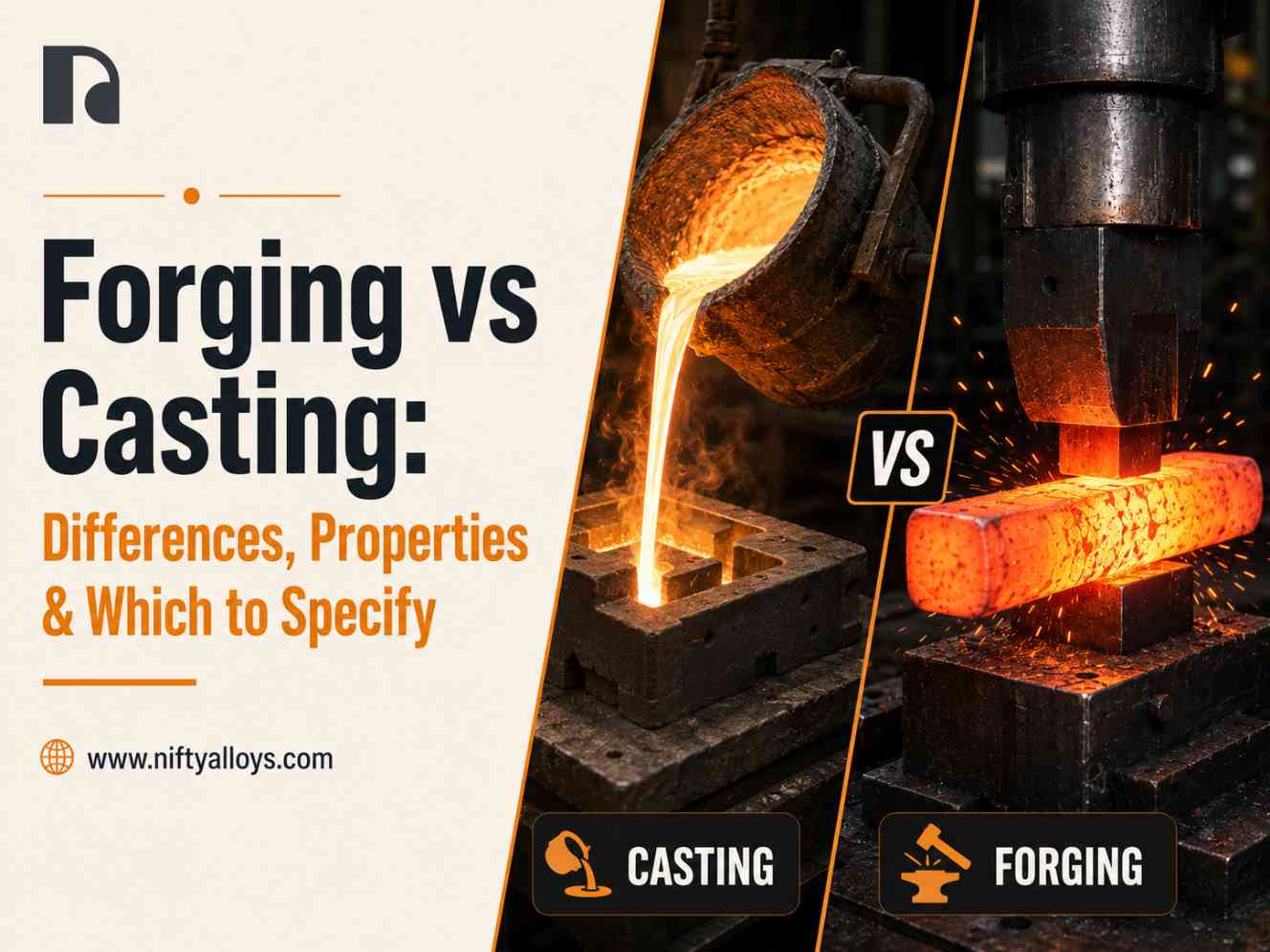
What Is Forging?
Forging is a metal-shaping process where a solid billet is deformed under compressive force — using a hammer, press, or upsetting die — until it takes the desired shape. The metal is worked below or near its recrystallization temperature (hot forging) or at room temperature (cold forging), depending on the alloy and the required properties.
Because the material is never melted, forging preserves and reshapes the internal grain structure. The grain flow bends to follow the contour of the finished part rather than being cut across, which is the primary reason forged components resist fatigue and impact loading better than cast equivalents of the same alloy.
Common forging methods include:
- Open-die forging — for large, simple shapes such as shafts and blanks
- Closed-die (impression) forging — for parts with more defined geometry, using shaped dies
- Upset forging — for increasing the diameter of a bar section, common in flange and fastener production
What Is Casting?
Casting is a process where molten metal is poured into a mold cavity and allowed to solidify into the desired shape. Because the metal is liquid during forming, casting can produce far more geometric complexity than forging in a single step — internal cavities, thin walls, and irregular external profiles are all achievable without secondary machining.
The resulting grain structure is determined by how the metal solidifies and cools inside the mold, rather than by directional deformation. This generally produces a more uniform, non-directional grain pattern, but also introduces a higher risk of internal defects such as porosity, shrinkage cavities, and inclusions if the pour and cooling are not tightly controlled.
Common casting methods include:
- Sand casting — cost-effective for large or one-off components
- Investment (lost-wax) casting — for high dimensional accuracy and complex detail
- Centrifugal casting — commonly used for cylindrical components such as pipe fittings and sleeves
Forging vs Casting: Comparison Table
| Factor | Forging | Casting |
| Grain structure | Directional, follows part contour | Non-directional, solidification-based |
| Mechanical strength | Higher tensile and yield strength | Moderate, alloy-dependent |
| Fatigue resistance | Superior | Lower, more prone to crack initiation at porosity |
| Impact toughness | Higher | Lower, especially at low temperatures |
| Porosity risk | Minimal | Present unless tightly process-controlled |
| Geometric complexity | Limited by die and deformation | High — complex internal/external shapes possible |
| Dimensional tolerance (as-formed) | Moderate, often needs machining | Can be closer to net shape |
| Typical lead time | Longer for custom dies | Shorter for one-off complex shapes |
| Typical defect types | Laps, seams, incomplete fill | Porosity, shrinkage, inclusions, cold shuts |
Mechanical Property Differences
For the same alloy composition, forged components typically outperform cast components in:
- Tensile and yield strength — grain flow alignment increases load-bearing capacity along the primary stress axis
- Fatigue life — fewer internal discontinuities means fewer crack-initiation sites under cyclic loading
- Impact toughness — particularly relevant for low-temperature or shock-loading service, such as marine and offshore applications
Castings can be engineered to close much of this gap through controlled solidification, hot isostatic pressing (HIP), and post-cast heat treatment, but this adds cost and lead time. For components under continuous cyclic stress or pressure — flanges, valve bodies, shafts, fasteners — forging remains the default specification in most industrial codes and standards.
Which Industries and Applications Use Which
Forging is typically specified for:
- Flanges, valves, and fittings in high-pressure oil and gas systems
- Shafts, couplings, and rotating equipment components
- Fasteners and load-bearing structural hardware
- Marine propulsion and mooring hardware subject to cyclic and shock loads
Casting is typically specified for:
- Pump housings and complex-geometry valve bodies where forging is impractical
- Large, irregularly shaped structural components
- Parts where internal cavities or thin-wall sections are required in a single forming step
- Lower-stress components where cost and design flexibility outweigh peak mechanical performance
Material Considerations by Alloy Family
Forgeability and castability vary significantly across alloy families, which affects both process selection and sourcing:
- Carbon and alloy steels — generally excellent forgeability; widely available as both forgings and castings
- Stainless steels — forge well in austenitic and duplex grades; castable grades (CF8, CF8M) are common for pump and valve bodies
- Duplex and super duplex stainless steels — forging is preferred for pressure-retaining components due to superior toughness and resistance to microstructural issues that can arise during casting solidification
- Nickel alloys — both forged and cast forms are used, but forged nickel alloy components are generally specified for the most demanding sour service and high-temperature applications
- Titanium alloys — forging is the dominant route for aerospace and high-performance components, given titanium's sensitivity to casting-related porosity
Certification and Traceability
Whichever process is specified, material traceability and certification remain essential for procurement and QA/QC sign-off. Forgings and castings typically require different inspection regimes — forgings are commonly verified through ultrasonic testing and mechanical testing of prolongations, while castings often require radiographic or dye-penetrant inspection to detect internal porosity. In both cases, buyers should request EN 10204 3.1 or 3.2 certification confirming the material's composition, mechanical properties, and process route before acceptance.
Decision Guide
Use this simple logic when specifying between forging and casting:
- Is the component under high cyclic stress, pressure, or impact loading? → Specify forging.
- Does the part require complex internal geometry not achievable by machining a forged blank? → Consider casting, with enhanced NDT requirements.
- Is this a safety-critical or sour-service application? → Forging is generally the default unless project specifications state otherwise.
- Is the priority cost and lead time for a complex one-off shape? → Casting may be more practical.
When in doubt, the governing project specification, client standard, or code (API, ASME, EN) will typically state the required process — always confirm against the applicable specification before sourcing.
FAQ
Is forged steel stronger than cast steel?
For the same alloy, forged steel generally has higher tensile strength, fatigue resistance, and impact toughness due to its aligned grain structure and lower porosity risk.
Can a component be cast and then forged?
This is uncommon in standard industrial practice. Forging and casting are generally treated as distinct process routes from the initial billet or pour stage, though hybrid processes exist in specialized manufacturing.
Which is cheaper, forging or casting?
Casting is often more cost-effective for complex one-off or low-volume shapes, since it avoids the cost of forging dies. Forging becomes more cost-competitive at higher volumes and where superior mechanical properties are required.
Which has better fatigue resistance, forging or casting?
Forging generally offers better fatigue resistance because its directional grain structure and lower internal porosity reduce the number of potential crack-initiation sites under cyclic loading.
Do oil and gas standards require forged components?
Many oil and gas project specifications require forged flanges, valves, and fittings for pressure-retaining, safety-critical service, though this depends on the specific code, client specification, and application.
Get Certified Forged and Cast Material Supply
Nifty Alloys LLC supplies certified forged and cast components in carbon steel, alloy steel, stainless steel, duplex and super duplex stainless steel, nickel alloys, and titanium to buyers across the UAE, GCC, and global markets. Whether your project specification calls for forged flanges and fittings or cast components for complex geometries, our team can support sourcing with full material traceability and certification. Contact Nifty Alloys for material availability and quotation support on your next procurement requirement.
 Let's Talk
.61bb46d8.png&w=640&q=75)
Ti-6Al-4V (ASTM Grade 5, UNS R56400) is the most widely used titanium alloy globally, accounting for...
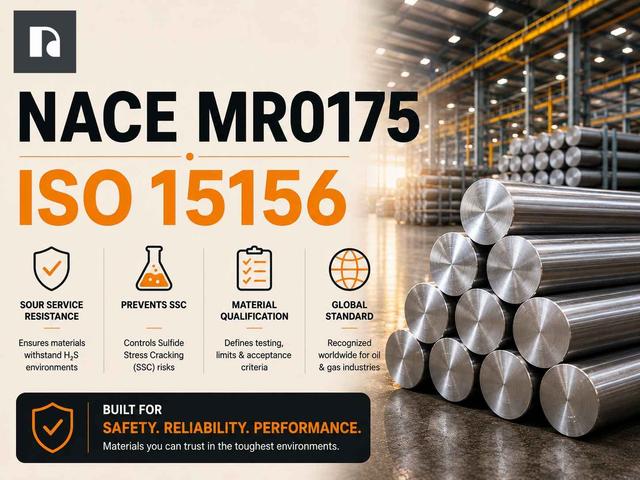
NACE MR0175 / ISO 15156 is the internationally recognised standard for selecting metallic materials ...
EN 10204 defines inspection document types for metallic products. Type 2.2 is a manufacturer's test ...




Elevate Your Projects with
with
 Our Superior Steels
