

Stainless Steel in Petrochemical Plants: Grades and Uses
Petrochemical plants use 304L and 316L for general process service, 321 and 347 for high-temperature service and resistance to polythionic acid cracking, 310 for furnace parts, 410S for cladding and valve trim, duplex 2205 where chlorides cause stress corrosion cracking, and 904L or 6Mo grades for aggressive acids. Selection is driven by temperature, chlorides, sulfur compounds and shutdown conditions.
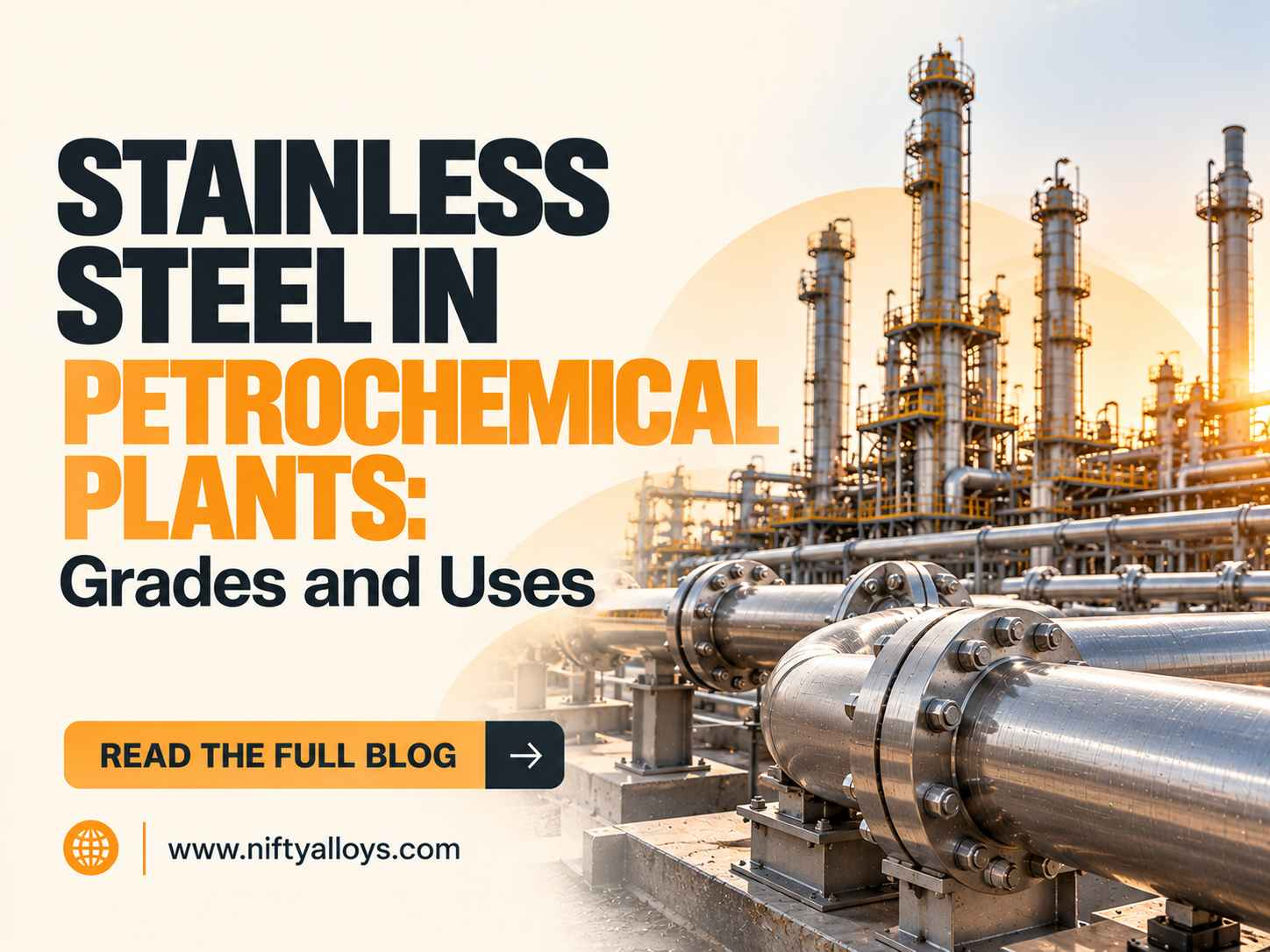
Walk through any petrochemical complex and stainless steel is everywhere: process piping, heat exchanger tubes, reactor internals, furnace parts, cryogenic lines and storage tanks. But it is never just "stainless steel". A plant may use a dozen different grades, each chosen to resist a specific combination of temperature, chemistry and stress.
This guide explains which stainless steel grades petrochemical plants use, where each one goes, and the failure mechanisms that drive those choices.
Why Is Stainless Steel Used in Petrochemical Plants?
Petrochemical processes handle hydrocarbons, acids, sulfur compounds, hydrogen and water at temperatures from cryogenic to well above 800 °C. Carbon steel works for much of the plant, but it corrodes in wet acidic streams, scales and loses strength at high temperature, and becomes brittle in cold service. Stainless steel fills those gaps with a chromium oxide film that resists corrosion, good strength and oxidation resistance at temperature, and, in the austenitic grades, toughness down to cryogenic temperatures.
Which Stainless Steel Grades Are Used, and Where?
| Grade | Key feature | Typical petrochemical use |
| 304L | Low carbon, general corrosion resistance, cryogenic toughness | General process piping, storage tanks, ethylene and LNG cold service |
| 316L | 2–3% molybdenum for better chloride and acid resistance | Most common process piping, heat exchanger tubes, vessel internals |
| 317L | 3–4% molybdenum | More aggressive acid and chloride streams |
| 321 | Titanium stabilised | High-temperature piping, expansion bellows, hydroprocessing units |
| 347 | Niobium stabilised; more stable through welding | Hydroprocessing reactor effluent piping, weld overlay, furnace components |
| 304H / 316H / 347H | Higher carbon for creep strength | High-temperature piping and tubes above about 540 °C |
| 310 / 310S | 25% chromium, 20% nickel; oxidation resistant | Furnace parts, burner components, refractory anchors |
| 410 / 410S | 12% chromium martensitic or ferritic | Column cladding for sulfidic corrosion, valve trim, tray components |
| 2205 duplex | High strength, chloride SCC resistance | Cooling water heat exchangers, chloride-bearing process streams |
| 904L / 6Mo | High nickel and molybdenum | Sulfuric acid service, high-chloride streams |
Nifty Alloys stocks a range of these grades; see our stainless steel product range for available forms.
What Failure Modes Drive Stainless Steel Selection?
Grade selection in petrochemical plants is mostly about avoiding a short list of well-known damage mechanisms, documented in API RP 571.
Chloride stress corrosion cracking
Standard austenitic grades such as 304L and 316L can crack when tensile stress, chlorides and temperatures above about 60 °C combine. A common case is external chloride SCC under insulation, where rainwater leaches chlorides from insulation or the atmosphere onto hot pipe. Mitigations include coating hot stainless steel before insulating, using low-chloride insulation to ASTM C795, or switching to duplex 2205, which resists chloride SCC far better.
Sensitisation and intergranular corrosion
Holding standard 304 or 316 between roughly 425 °C and 815 °C, including during welding, can form chromium carbides at the grain boundaries and leave the steel open to intergranular attack. Low-carbon L grades reduce this risk at ambient process temperatures. For continuous high-temperature service, the stabilised grades 321 and 347 tie up carbon with titanium or niobium instead.
Polythionic acid stress corrosion cracking
This is a refinery and petrochemical speciality. Sulfide scale forms on stainless steel during operation; when the unit is shut down and opened, air and moisture convert it to polythionic acid, which cracks sensitised stainless steel. Stabilised 321 and 347, ideally given a thermal stabilisation heat treatment, are used in susceptible units, and shutdowns follow NACE SP0170 practices such as nitrogen purging or soda ash washing.
High-temperature sulfidation and naphthenic acid corrosion
Sulfur compounds attack carbon steel at high temperature, so towers and lines handling hot sulfur-bearing streams are often clad with 410S or built in 300-series stainless. Naphthenic acid corrosion in hot crude and vacuum units is resisted by molybdenum-bearing grades such as 316 and 317, with at least about 2.5% molybdenum often specified.
321 vs 347: Which Stabilised Grade?
Both resist sensitisation in high-temperature service. The practical difference is welding: titanium in 321 tends to oxidise and be lost across the welding arc, so 321 base metal is normally welded with 347 filler metal. Many owners standardise on 347 for welded high-temperature systems and weld overlay, using 321 mainly for sheet, bellows and other formed parts.
Warning: Correct Grade, Wrong Condition
Many stainless steel failures in petrochemical plants trace back to condition, not grade. A 316 component that has been sensitised by welding, a 347 part without thermal stabilisation in a unit prone to polythionic acid, or 304L insulated without a coating at 80 °C can all fail even though the grade on the certificate is correct. Specify heat treatment, carbon limits and fabrication controls as well as the grade.
When Is Stainless Steel Not Enough?
Stainless steel has limits. Hot concentrated chlorides, hydrochloric acid, wet chlorine and many mixed acid streams need nickel alloys such as Alloy 625, Incoloy 825 or Hastelloy C-276. Our comparison of Inconel, Hastelloy and Monel explains which family suits which environment, and our nickel alloy range covers the grades we supply.
What Should Buyers Specify?
- Grade and UNS number: for example UNS S31603 for 316L, so that dual-certified material is unambiguous.
- Product standard: ASTM A240 for plate, A312 for pipe, A213 for heat exchanger tubes, A182 for forgings and A479 for bar.
- Carbon limits: L grades for welded corrosion service; H grades for creep service, with carbon and grain size reported.
- Heat treatment: solution annealed, or thermally stabilised for 321 and 347 where polythionic acid is a risk.
- Certification: EN 10204 3.1 as a minimum. Our EN 10204 2.2 vs 3.1 vs 3.2 guide explains when 3.2 is needed.
Frequently Asked Questions
What is the most common stainless steel in petrochemical plants?
316L is the most widely used for process piping and heat exchangers, followed by 304L for less aggressive service.
Why use 321 or 347 instead of 304?
Because they resist sensitisation during long exposure between about 425 °C and 815 °C, and with the right heat treatment they resist polythionic acid stress corrosion cracking during shutdowns.
At what temperature does chloride stress corrosion cracking become a risk?
For 304L and 316L, the risk generally rises above about 60 °C when chlorides and tensile stress are present, which is why insulated hot stainless steel needs protection.
Is duplex stainless steel used in petrochemical plants?
Yes. Duplex 2205 is widely used where chloride stress corrosion cracking would be a risk for 300-series grades, such as cooling water heat exchangers and chloride-bearing process streams.
Certified Stainless Steel from Dubai
Nifty Alloys LLC supplies austenitic, duplex and super duplex stainless steels to petrochemical, refining and process industry buyers across the UAE, GCC and export markets. Every order ships with an EN 10204 3.1 mill test certificate, reviewed by our QA/QC team under our quality and certification standards.
Send our team your process conditions and grade requirements, and we will confirm grade, condition and certification before quoting.
 Let's Talk

Aircraft use aluminium because it is about one-third the density of steel while offering good streng...
Oil and gas relies mainly on carbon and low-alloy steels, upgraded to corrosion-resistant alloys whe...
Super duplex is used in firewater and seawater piping because its PREN of 40 or more resists pitting...
A complete nickel alloy bar order states the UNS number, the ASTM or ASME product standard and grade...




Elevate Your Projects with
 Our Superior Steels
